Business Analysis Digital Intelligence

Specs in hours,
not weeks.

One platform that holds every specification, every business rule and every tracking board — so a business analyst starts from the evidence, not from a blank page.

1.5 weeks per specification→Same day
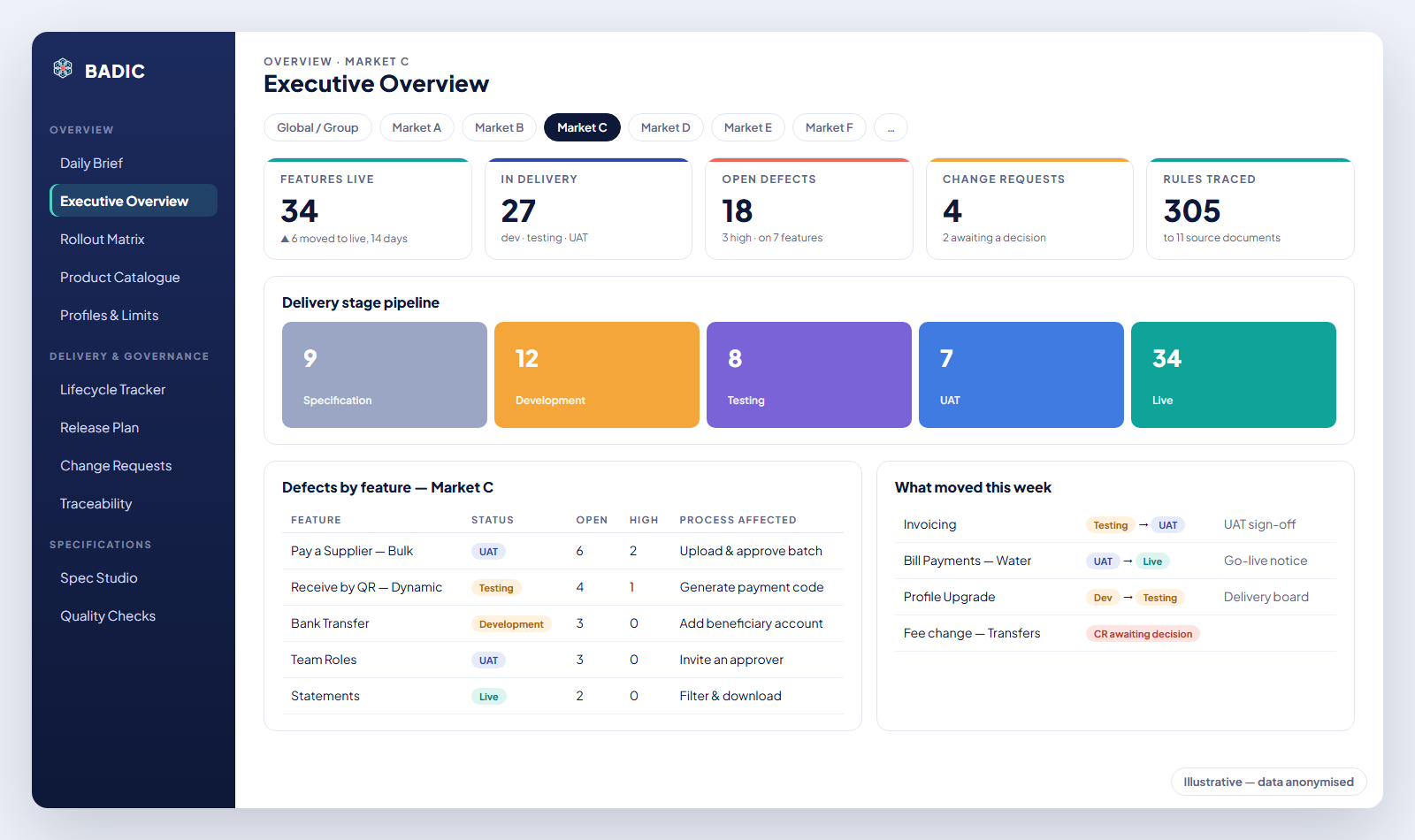
Illustrative market overview: features live, in delivery, open defects, change requests and rules traced, with a delivery stage pipeline and defects by feature.
588
specifications and working documents consolidated
3,593
business rules, each traced to its source
9
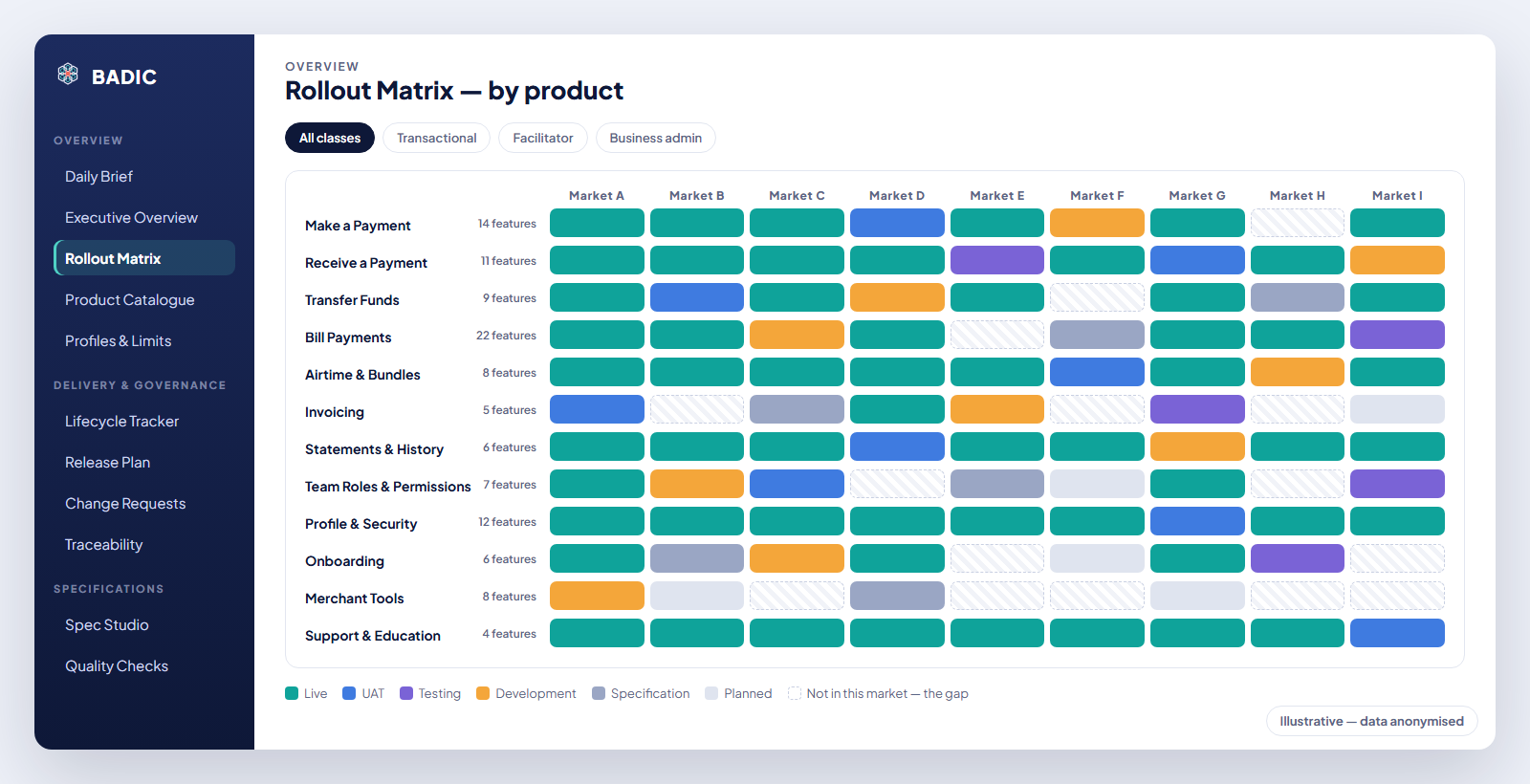
markets tracked side by side
15
tracking boards read into one view
The problem

One product name.
Nine different products.

A product carries the same name in every market — but its offering, its rules and its limits differ by user type and by legislation. It is built by different delivery teams and tracked across many boards.

  • 820 feature-in-market combinations, each with its own status, rules and bugs.
  • 99% of business rules are market-specific. One market's rule in another market's spec reads as correct — and isn't.
  • Differences are explained, not guessed: forced by a regulator, or chosen and open to harmonising.
Market A LiveSingle, multiple & bulk · second-user approval
Market B UATSingle only · different daily limit (regulator)
Market C In developmentBuilt by a different delivery team
Market D LiveFallback channel for low-bandwidth users
Market E GapNot offered — a choice, or a constraint?
Market F LiveFees, levy and tax differ by user profile
The platform

Four jobs, one place.

Detection is a query. Judgement stays with the analyst.

▦

Consolidate

Every specification filed with its market, version, date and status. Rules and process flows extracted row by row. Nothing is filed until a person confirms it.

◷

Track

Rollout status per feature, per market, from every tracking board. Bugs, blockers and change requests sit on the feature they affect. A morning brief says what changed.

✎

Draft

BRDs, user stories, functional specs and designs, written from one market's evidence only. Borrowed content is marked "to confirm" — never passed off as fact.

✓

Check

Every statement traced to its source. Gaps, stale rules and untested scenarios flagged automatically. Who changed what, and when, always recorded.

How it was built

Before writing a line, I mapped the mess.

Accuracy first. Speed follows.

Unpack

Hundreds of specs from several authoring teams; versions that contradicted each other; trackers that disagreed.

Clean

Every document given a market, version, date and status. Superseded drafts kept as history, never deleted.

Design

Knowledge, delivery state and templates kept separate — meeting only at the feature, in a market.

Sequence

Each document written from the one above it, so decisions made upstream reach everything below.

Control

Confirm before filing. Trace every statement. Automated quality checks. A full audit trail.

Discovery→Workshop→BRD→User stories→Functional spec→Design
Inside the platform

One view of every market.

Screens are illustrative recreations with anonymised data.

Where the time went

The writing was never the slow part.

Before
~1.5 weeks
  • Hunting for the latest version of every spec days
  • Reconciling trackers that disagree days
  • Checking what each market actually does days
  • Drafting from a blank template days
  • Cross-checking for gaps and copy-paste errors hours
Now
Same day
  • Pick the feature and the market minutes
  • See its rules, flows, status and open bugs instant
  • Confirm the key decisions up front minutes
  • Draft, grounded in that market's evidence under an hour
  • Automated checks, then review and sign-off hours
See it working

Request a demo.

If your team rolls one product out across several markets, delivery teams and tracking boards, I'd be glad to walk you through how the platform handles it.

  • 30 minutes, live, on anonymised data
  • Your scenario — bring a feature and a few markets

Your details are used only to arrange the demo.